Centennial Nobel
Quantum Entanglement Teaching & Research System
The 2022 Nobel Prize in Physics was awarded to Alain Aspect, John F. Clauser, and Anton Zeilinger "for experiments with entangled photons, establishing the violation of Bell inequalities and pioneering quantum information science."
The Quantum Entanglement Teaching & Research System, developed by Jiuzhang Quantum, utilizes the Spontaneous Parametric Down-Conversion (SPDC) process in nonlinear crystals to generate polarization-entangled photon pairs. By controlling and detecting entangled photons, the system enables users to verify the fundamental properties of quantum entanglement and disprove Bell's inequality, as well as confirm the single-photon nature of the entanglement source via the Hanbury Brown and Twiss (HBT) experiment. Supporting full-chain quantum state manipulation and characterization, this system provides versatile quantum state comparisons, helping students intuitive understand the diversity and control methods of entangled states.

Product Highlights

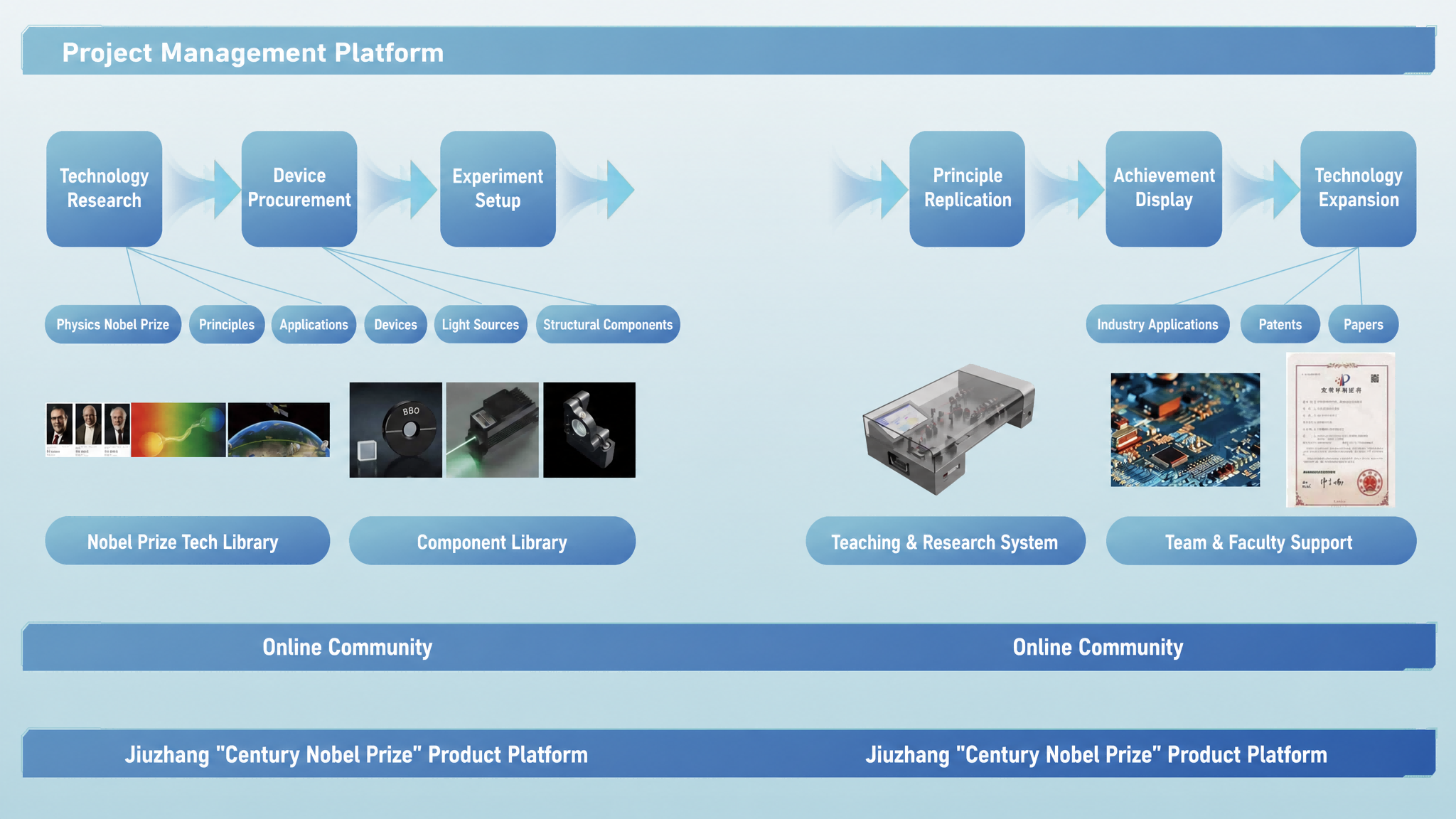
Turnkey Solution: Paired with tools and teaching methods from Jiuzhang’s "Centennial Nobel Prize" product platform to cultivate comprehensive scientific research capabilities.

Hands-on Application: Expands beyond basic setups to explore advanced research experiments, including the preparation of four Bell states, calculation of state fidelities, single-photon characterization, and analysis of laser power effects on single-photon purity.

Turnkey Solution: Paired with tools and teaching methods from Jiuzhang’s "Centennial Nobel" product platform to cultivate comprehensive scientific research capabilities.
Product Highlights
Modular Design: Self-assembly of the optical path with swappable optical units allows for direct exploration of experimental principles.
Hands-on Application: Expands beyond basic setups to explore advanced research experiments, including the preparation of four Bell states, calculation of state fidelities, single-photon characterization, and analysis of laser power effects on single-photon purity.
Turnkey Solution: Paired with tools and teaching methods from Jiuzhang’s "Centennial Nobel" product platform to cultivate comprehensive scientific research capabilities.
Key Research Topics
01 Constructing and aligning optical paths
02 Preparing four Bell states
03 Plotting polarization correlation curves of entangled photons
04 Calculating the fidelity of four Bell states
05 Verifying the violation of Bell's inequality
06 Verifying the single-photon nature of the entanglement source using the HBT experiment
07 Analyzing the impact of laser power on single-photon purity
Key Research Topics
01 Constructing and aligning optical paths
02 Preparing four Bell states
03 Plotting polarization correlation curves of entangled photons
04 Calculating the fidelity of four Bell states
05 Verifying the violation of Bell's inequality
06 Verifying the single-photon nature of the entanglement source using the HBT experiment
07 Analyzing the impact of laser power on single-photon purity

Specifications
JZNobel-QE-01
| Parameter | Specification |
| Single-Photon Brightness |
>1×10⁵ cps |
| Correlated Photon Pairs | >1×10⁴ cps |
| Entangled Photon Pairs | >5×10³ cps |
| H/V Contrast Ratio |
≥30:1 |
| +/− Contrast Ratio | >7:1 |
| Bell Inequality Violation Value | >2.4 |
| Entangled State Fidelity |
>85% |
| Single-Photon Purity g2(0) |
<0.02 |
Specifications
JZNobel-QE-01
| Parameter | Specification |
| Single-Photon Brightness |
>1×10⁵ cps |
| Correlated Photon Pairs | >1×10⁴ cps |
| Entangled Photon Pairs | >5×10³ cps |
| H/V Contrast Ratio |
≥30:1 |
| +/− Contrast Ratio | >7:1 |
| Bell Inequality Violation Value | >2.4 |
| Entangled State Fidelity |
>85% |
| Single-Photon Purity g2(0) |
<0.02 |
End-to-End Educational & Research Solutions

Nobel Prize Knowledge Base
Detailed history of the Nobel Prizes in Physics, scientific principles, and laureate introductions.

Experimental Instruments
In-depth explanations and operational guides for Nobel-related physics experimental instruments.

Teaching Resources
Rich and diverse lesson plans, lab manuals, and academic materials.

Management Tools
Efficient research project management tools to empower team collaboration.

Telephone: +86 4008165520
E-mail:service@jiuzhangqt.com
Address: 11th Floor, Building C, Big Data Industry Base, High-Tech Zone, Jinan, Shandong Province
Copyright © Jiuzhang (Jinan) Quantum Technology Co., Ltd. All Rights Reserved. 鲁ICP备2023015890号
Scan the QR Code
Follow Our Official WeChat Account