Centennial Nobel
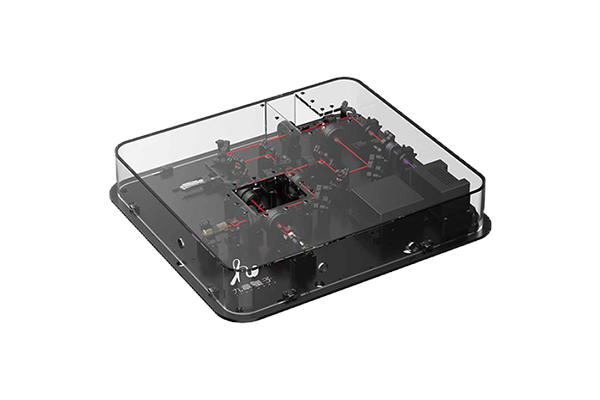
Quantum Computing Prototype for Education
Quantum computers are computing systems that harness quantum mechanical effects using quantum bits (qubits). For specific complex problems, quantum computing possesses unique advantages, offering solutions to tasks beyond the reach of classical computers.
This product constructs quantum logic gates via linear optical components, enabling single-qubit logic gate experiments (such as Pauli-X, Pauli-Z, and Hadamard gates), two-qubit logic gate experiments (such as Controlled-NOT and Controlled-Z gates), as well as the Deutsch-Jozsa (D-J) algorithm.
Featuring a modular design that balances educational utility with technological aesthetic appeal, the instrument includes a comprehensive suite of teaching materials—such as lab manuals, courseware, and lecture slide decks matched to experimental workflows—helping universities rapidly implement quantum information laboratory courses.
Product Advantages

High Operability

Strong Expandability

Compact Modular Design

No Darkroom Required

High Detection Efficiency

Low Accidental Coincidence Count
Product Advantages
High Operability
Strong Expandability
Compact Modular Design
No Darkroom Required
High Detection Efficiency
Low Accidental Coincidence Count
Experimental Content
01 Optical Path Setup and Alignment
02 Preparation of Polarization-Correlated Photon Pairs
03 Single-Qubit Quantum Logic Gate Experiments
04 Two-Qubit Quantum Logic Gate Experiments
05 Deutsch-Jozsa (D-J) Algorithm Demonstration Experiment

Optical Path Schematic
Experimental Content
01 Optical Path Setup and Alignment
02 Preparation of Polarization-Correlated Photon Pairs
03 Single-Qubit Quantum Logic Gate Experiments
04 Two-Qubit Quantum Logic Gate Experiments
05 Deutsch-Jozsa (D-J) Algorithm Demonstration Experiment
Optical Path Schematic
Specifications
JZQCE-DJ-01
| Parameter | Specification |
| Single-Channel Photon Brightness | >8×10⁴ cps |
| Correlated Photon Pairs | >8×10³ cps |
| Detector Dark Count | <500 cps |
| Detection Efficiency @ 810 nm | ≥65% |
| Interference Contrast Ratio | 1:3~1:5 |
| State Conversion Efficiency |
>45% |
| Software Features | Count display, coincidence counting, data acquisition & saving, experiment selection, demo videos |
| Dimensions | Main Unit: 445×400×90 mm³ Coincidence Counting Module Box: 320×215×50 mm³ |
| Weight | Main Unit: 10 kg Coincidence Counting Module Box: 3 kg |
| Operating Temperature | 25±5 ℃ |
| Operating Humidity | 0%~45% RH |
Specifications
JZQCE-DJ-01
| Parameter | Specification |
| Single-Channel Photon Brightness | >8×10⁴ cps |
| Correlated Photon Pairs | >8×10³ cps |
| Detector Dark Count | <500 cps |
| Detection Efficiency @ 810 nm | ≥65% |
| Interference Contrast Ratio | 1:3~1:5 |
| State Conversion Efficiency |
>45% |
| Software Features | Count display, coincidence counting, data acquisition & saving, experiment selection, demo videos |
| Dimensions | Main Unit: 445×400×90 mm³ Coincidence Counting Module Box: 320×215×50 mm³ |
| Weight | Main Unit: 10 kg Coincidence Counting Module Box: 3 kg |
| Operating Temperature | 25±5 ℃ |
| Operating Humidity | 0%~45% RH |
Educational Scenarios


Educational Scenarios

Telephone: +86 4008165520
E-mail:service@jiuzhangqt.com
Address: 11th Floor, Building C, Big Data Industry Base, High-Tech Zone, Jinan, Shandong Province
Copyright © Jiuzhang (Jinan) Quantum Technology Co., Ltd. All Rights Reserved. 鲁ICP备2023015890号
Scan the QR Code
Follow Our Official WeChat Account